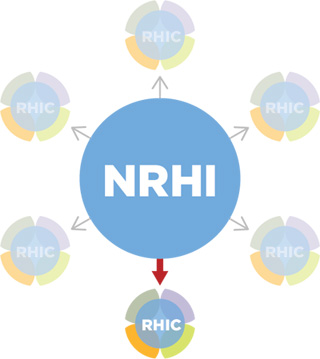

In September 2015, the Centers for Medicare & Medicaid Innovations (CMMI) awarded $685 million to 39 national and regional collaborative healthcare transformation networks and supporting organizations to provide technical assistance support to help equip more than 140,000 clinicians with tools and support needed to improve quality of care, increase patients’ access to information, and spend dollars more wisely. The Transforming Clinical Practice Initiative (TCPI) is one of the largest federal investments uniquely designed to support clinician practices through nationwide, collaborative, and peer-based learning networks that facilitate practice transformation. The Network for Regional Healthcare Improvement (NRHI), a national network of 35 regional health improvement collaboratives, is one of the 39 TCPI partners. As such, NRHI will identify and elevate the local innovations of RHICs to a national level to move practices toward greater value and alternative payment methodologies.
Learn more about the Transforming Clinical Practice Initiative on the Healthcare Communities website.
Project Updates & PresentationsWhat is the Network for Regional Healthcare Improvement?
What are Regional Health Improvement Collaboratives?
For more information:
Why Are Regionally Based Strategies More Effective for Transformation?
Moreover, since the healthcare stakeholders in a community—consumers, physicians, hospitals, health plans, businesses, government, etc.—will be affected in important ways, each stakeholder needs to be involved in planning and implementing changes. In many communities, there is considerable distrust between different stakeholder groups pointing to the need for a neutral facilitator to help design “win-win” solutions.
Many communities across the country recognize that RHICs are an ideal mechanism for developing coordinated, multi-stakeholder solutions to transform how healthcare is delivered and paid for. A RHIC does not deliver health care services directly or pay for such services; rather, it provides a neutral, trusted mechanism through which the community can plan, facilitate, and coordinate the many different activities required for successful transformation of its healthcare system.
What Is NRHI’s High-Value Care Learning Program for PTNs and Clinicians?
High-Value Care Learning Program Component: Total Cost of Care
Over the past decade, there have been extensive efforts to measure and improve the quality of healthcare services in the United States. In communities all across the country, physicians, hospitals, health plans, government agencies and community organizations are measuring the quality of care and implementing initiatives to improve quality. While much still remains to be done to improve the quality of healthcare services, concern about the cost of healthcare services has become an equal or greater concern for the nation, since high quality care is of little good if patients cannot afford to obtain it. Furthermore, improvements in the quality process have not yet yielded expected measurable savings. In fact, the costs of healthcare have continued to rise. In response, the conversation has shifted to improving value, which encompasses both cost and quality. Purchasers and consumers are increasingly demanding accountability for cost and seeking to differentiate among providers and practices that manage resources effectively. Finally, as physicians increasingly enter risk contracts, they need transparent cost and utilization data to be successful in managing population health and costs. The first step to ensuring that resources are well used is to know where they are being used. Ultimately, payment reform will be advanced by understanding, measuring and reporting TCoC.
NRHI has led the Total Cost of Care Multi-Region Innovation Pilot for the Robert Wood Johnson Foundation since 2013. The initiative supports physicians, practices and RHICs in five geographic areas (two more sites are being added this year) developing and producing information to ultimately enable communities to understand and reduce the total cost of care in multiple regions with replicable, multi-stakeholder driven strategies. The RHICs are analyzing claims data and calculating total cost; identifying differences in total cost for apple-to-apples comparisons; and learning how to share this information in a professional, appropriate, and meaningful way with physicians so that they have knowledge of costs associated with their care delivery and referral patterns and tools for impacting cost drivers. Through analysis of cost information, communities are identifying the key drivers of TCoC /high-value care, which, in turn, allow providers to adopt evidence-based interventions and best practices in response to the cost drivers. Best practices, strategies, expertise, tools and materials from the RWJF project, including a curriculum and training to teach other regions to produce TCoC results using their regional data, will be leveraged for TCPi.
While they will not calculate TCoC for their individual practice, clinicians participating in NRHI’s SAN will understand what TCoC is, why we need to talk about it, what practices in five regions are learning about it, where the field is headed, clinician concerns around TCoC, perceived patient concerns, etc. Two leaders in this field, Minnesota Community Measurement (MNCM) and the Institute for Clinical Systems Improvement (ICSI), will serve as clinical and QI expert faculty for this part of the program. MNCM released the country’s first report on TCoC at the practice leveli, and ICSI is a leader in engaging clinicians in an authentic and effective way around the difficult conversations about cost of care and appropriate care.
High-Value Care Learning Program Component: Care Transitions and Care Management
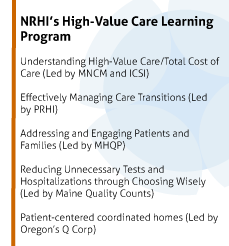 discharges attributed back to PCPs. PRHI will leverage expertise and tools developed in the Primary Care Resource Center Project.1 The PCRCP is a $10.4 million, 3-year PRHI demonstration project, funded by the CMMI which creates and tests a novel model of support for PCPs affiliated with community hospitals. The main clinical targets of the project are to reduce 30-day all-cause readmission rates for chronic obstructive pulmonary disease (COPD), heart failure, and acute myocardial infarction by 40% from historical baselines. Funding is used to create a care coordination team at each of 6 community hospitals in western Pennsylvania and West Virginia, composed of experienced nurses and pharmacists specifically trained in care transitions, readmission reduction, and advanced primary care, using existing PRHI curricula. The project also adapts methods validated in studies such as Project BOOST2 and the Transitional Care Model3, but customizes the care around the three high-volume conditions and for the host facility’s resources and primary care practice community. Early projections estimate potential Medicare cost savings of up to $43 million over the term of the grant. The project has been recognized for reducing preventable COPD readmissions4 and defining a critical role for the ambulatory pharmacist5.
High-Value Care Learning Program Component: Engaging Patients and Families
MHQP has worked extensively with consumers and has experience recruiting and supporting an active Consumer Health Council whose members are integrated and engaged in MHQP’s work. MHQP’s governance reflects consumer representation on all of MHQP’s governance and workgroups. MHQP also has lead two broad community coalitions, the MA Child Health Quality Coalition and the Healthier Roxbury Coalition, engaging patients, families and community members to improve care. MHQP brings its expertise, tools, and strategies from these and other efforts in capturing patient experience and patient, family and community engagement to the participants in NRHI’s SAN.
High-Value Care Learning Program Component: Reducing Inappropriate Utilization through Choosing Wisely
High-Value Care Learning Program Component: Patient-Centered Medical Homes
What is the Structure of the High-Value Care Learning Program, and What is the Time Commitment?
- A virtual kick-off meeting for each High-Value Care cohort. The kick-off meeting will give PTNs and their clinicians an overview of the program, and a foundation into total cost of care/high-value care concepts. The agenda will include an overview of the components that impact high-value care/TCoC so that PTNs and clinicians have a preview of the topics they will tackle in the year ahead. This event will be recorded and available for those unable to hear it live.
- Virtual learning events each month for each SAN. NRHI will convene two monthly videoconferences each on the core topics. The events will range from 90 minutes to 2 hours. NRHI will record virtual events so that those who miss them can listen after the fact, and will post materials on the HealthDoers Platform.
- Collaborative Health Network. The Collaborative Health Network provides trusted peer-to-peer forums and programming to support “HealthDoers” working to improve community health and healthcare. The online and in-person offerings of the Collaborative Health Network are designed to rapidly identify and spread what works, foster meaningful connections, and incorporate participant feedback to set priorities. The Collaborative Health Network’s HealthDoers Platform offers an online, invitation-only, learning community which will be used to connect with other stakeholders involved in delivery system and payment transformation. The HealthDoers Platform allows participants to crowd-source questions, post interesting articles and materials, ask questions of each other, and “meet” in virtual classrooms to hold events in a more personal way. NRHI will make available a private virtual classroom—a videoconference where participants can see and engage with each other and the faculty in real time—available only to participants in NRHI’s SAN.
- Dissemination of tools and materials. NRHI will gather, package, present, and disseminate a set of road-tested tools and materials on the HealthDoers Platform that PTNs and clinicians can adopt, including instructions on how the materials can be used. NRHI’s team will be flexible in terms of dialing up or down the amount of support headed by the PTN. Again, NRHI will leverage its 35-member network for widespread dissemination from SAN and TCPI.
- One-on-one coaching of PTNs. Individual mentoring will be available by individual NRHI faculty to a PTN upon request. For example, a PTN could receive one-on-one coaching from a clinical/QI expert for each core topic area over the course of the year. The coaching will provide individualized support to help PTNs brainstorm, plan, strategize, and use the tools most effectively to advance practices through the TCPI phases of transformation.
Who Are the Clinical and Quality Experts and Faculty?
 |
Elizabeth Mitchell, President & CEO, NRHI |
 |
Randy Cebul, MD, President & CEO, Better Health Partnership Northeast Ohio |
 |
Nancy Zionts, Chief Program and Operating Officer, PRHI |
 |
Kate Elliott, Program Director, Q-Corp |
 |
Lisa Letourneau, MD, Executive Director, Maine Quality Counts |
 |
Barbra Rabson, President & CEO, MHQP |
 |
Tina Frontera, Chief Operating Officer, MN Community Measurement |
 |
Cally Vinz, Vice President, ICSI |
 |
David Price, Senior Vice President, ABMS Research and Education Foundation and Executive Director, Multi-Specialty Portfolio Approval Program Organization, American Board of Medical Specialties |
NRHI’s informal partners include its national network of 35 regional health improvement collaboratives (RHICs). RHICs are non-profit, multi-stakeholder organizations working in their regions and collaborating across regions to transform the healthcare delivery system and achieve the Triple Aim. RHICs work directly with providers, provider organizations, commercial and government payers, employers, consumers, and other healthcare related organizations.
NRHI’s formal partners in this work include:
- Minnesota’s Institute for Clinical Systems Improvement;
- Minnesota Community Measurement;
- Pittsburgh Regional Health Initiative;
- Massachusetts Health Quality Partners;
- Maine Quality Counts;
- Oregon’s Health Care Quality Corporation;
- Cleveland’s Better Health Partnership Northeast Ohio; and
- The American Board of Medical Specialties.
Who is the NRHI SAN Team?